

The best provider for commercial facilities management in London isn’t automatically the largest. The right fit depends on your building, the services you need and whether one coordinated contract or separate specialist agreements will give you clearer oversight.
It’s understandable to compare providers by the range of services they cover. But breadth alone doesn’t show how responsibilities will be divided, how maintenance will be planned or who will coordinate work across your building.
This article explains how London providers differ by specialism and service scope, and compares bundled and separate contracts. It also covers how planned preventive maintenance supports asset management and which practical factors to weigh when choosing an approach. Use these points to decide what your building needs and how to organise the work.
Key Takeaways
- Match maintenance plans to each asset’s condition, use and operational importance to support its ongoing performance.
- Compare providers by their specialisms, service scope and how clearly they assign responsibility for compliance and coordination.
- Choose bundled contracts for joined-up oversight or separate agreements where distinct specialist control better suits your building.
- Consider whether one coordinated facilities management contract covering services such as cleaning and security would simplify day-to-day building operations.
Planned preventive maintenance and asset life
Planned preventive maintenance schedules inspections and servicing before equipment fails. CIBSE Guide M, the UK reference for maintenance engineering and management, has a 2023 edition. Use an asset register to record each item’s location, condition, service history and operational importance. Then prioritise work around manufacturer guidance, observed wear and the consequences of failure. A lift serving every floor needs different attention from a rarely used store-room fan.
BS EN 15221 defines facilities management as integrating processes that support an organisation’s primary activities. That principle links building maintenance with commercial cleaning, grounds maintenance and security. For example, cleaning staff may report a leaking tap or damaged entrance mat during routine work. A shared reporting route helps direct each issue to the right maintenance task, while grounds inspections can flag blocked drains or damaged paths.
CAFM systems help teams organise asset records, planned tasks, work orders and completion histories. Accurate records show managers overdue inspections and recurring faults across a portfolio. Predictive maintenance uses condition information, such as equipment readings or repeated fault reports, to help identify changes in performance. It supports better-informed planning, but does not replace inspections or competent assessment. Link each alert to an owner, an action and a recorded outcome.
Preventive and reactive maintenance address different needs. Preventive work follows a schedule, such as inspecting a plant-room pump and recording its condition. Reactive maintenance responds to a fault, such as arranging plumbing repairs when a leak disrupts an occupied office. Reviewing reactive work orders can reveal repeat failures, helping managers adjust planned tasks, investigate causes or consider whether an asset needs repair or replacement.
Related property maintenance includes electrical work, plumbing, fabric repairs and external upkeep. Grouping these tasks in one maintenance plan can clarify priorities and access requirements. For example, coordinate a lighting repair with ceiling access, then record the completed work against the relevant asset. This creates a useful history for future decisions and helps teams maintain building function without treating every fault as an isolated event.
Which are the best facilities management companies in London?
The right fit depends on your building’s risks, required services and how clearly the provider manages responsibility. Outsourcing risks include unclear accountability, weak subcontractor oversight and incomplete records, which can disrupt building operations.
Health and safety compliance
Assess how the provider identifies hazards, records incidents and assigns follow-up actions. A blocked fire exit, for example, needs a clear reporting route and prompt action, not just a note in a general maintenance log. Ask how site instructions reach employees and subcontractors, and how managers review outstanding issues. These processes show whether safety information supports day-to-day decisions.
FM certifications and subcontractor compliance
Certifications and licences should match the work being carried out. Subcontractor credentials should be checked against the work being carried out, with relevant qualifications and licences recorded for mechanical, electrical and security services. Check how subcontractor credentials are recorded and monitored throughout the contract. A clear register shows which organisation is responsible for each task and where supporting records are kept.
Building compliance and safety
For fire safety services in the UK, the Regulatory Reform (Fire Safety) Order 2005 is the key compliance requirement, according to UK legislation. Build this into the service scope by identifying who coordinates inspections, maintains records and escalates unresolved issues. For a new-build handover, organised documentation can help facilities teams understand installed systems and outstanding work. Clear reporting also helps property managers track actions across the building.
Use these criteria to compare providers against your building’s operational needs. A clearly defined facilities management service can bring maintenance coordination and building oversight into a single contract.
Bundled versus separate FM contracts
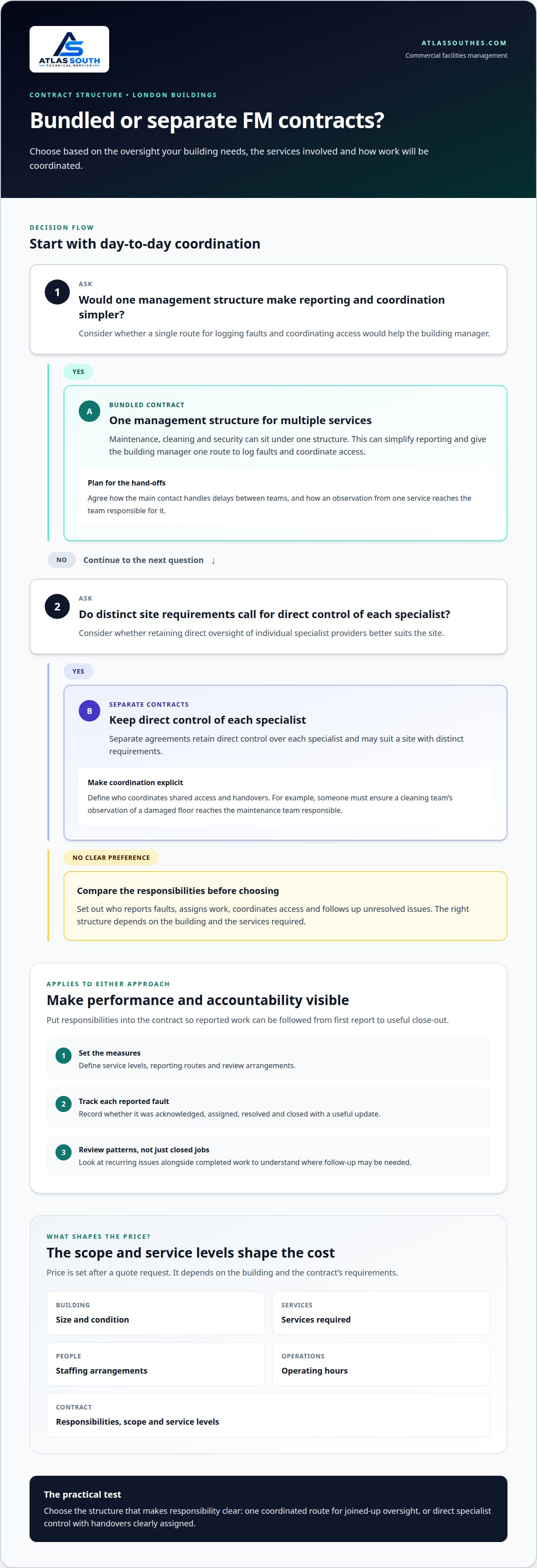
A bundled contract places services such as maintenance, cleaning and security under one management structure. This can simplify reporting, giving a building manager one route to log faults and coordinate access. Separate contracts retain direct control over each specialist, which may suit a site with distinct requirements. The trade-off is coordination: if a cleaning team spots a damaged floor, someone must ensure the observation reaches the maintenance team responsible.
What affects facilities management prices for London commercial buildings? The price depends on the building’s size and condition, services required, staffing arrangements, operating hours and contract responsibilities. It is set after a quote request, with the scope and service levels shaping the cost. A contract for one office differs from one coordinating cleaning, maintenance and security across several occupied sites.
Contractor performance management should make responsibilities measurable. Set out service levels, reporting routes and review arrangements in the contract. Record whether each reported fault was acknowledged, assigned, resolved and closed with a useful update. Review recurring issues alongside completed work, rather than relying only on a list of closed jobs. With a bundled provider, agree how the main contact handles delays between teams. With separate suppliers, define who coordinates shared access and handovers.
Contract cleaning also needs a clear scope. Specify which areas receive routine cleaning, the tasks for each area and how standards are recorded. An office reception may need regular attention, while a plant room requires controlled access and different cleaning procedures. In a bundled arrangement, connect cleaning reports with building operations so teams can flag faults. In separate agreements, define how cleaners report damage or hazards to the property manager.
Choose the contract structure that fits your management capacity. One agreement can reduce administration, while separate contracts can preserve specialist oversight. Compare both against the same service scope, reporting expectations and performance measures before deciding.
London facilities management providers and specialisms
London facilities management providers differ in the buildings they support and the work they coordinate. Some focus on a specialism, such as cleaning, security or mechanical and electrical maintenance. Others coordinate several services under one management structure. Don’t compare providers by service count alone. Match their strengths to your building’s systems, occupancy and operational priorities.
Scale also shapes the fit. A 500,000 square foot office campus presents different coordination needs from a single commercial building. A 24-hour-occupancy campus may require planned work around continuous use, alongside a route for urgent faults. Contracted providers can offer 24-hour reactive capability for emergency response. Consider how a provider’s coverage and service model align with access needs and the impact of interruptions.
Technical specialisms matter where a building depends on regulated work. Gas Safe and NICEIC/NAPIT are identified as compliance requirements for mechanical and electrical services, while security services have separate SIA licensing requirements. A provider coordinating these areas needs clear responsibility for assigning work and maintaining relevant records. Review the service boundaries, reporting process and how specialist tasks connect with wider building operations.
Switching providers calls for a structured handover. First, map current services, contract responsibilities, asset records and open work orders. Then set the required scope and service standards, and agree responsibilities and start dates with the incoming team. Transfer access arrangements, site procedures and outstanding issues so planned work and daily operations continue through the changeover.
Use these steps to compare providers against actual site requirements, rather than selecting by size alone. For a coordinated approach, discuss facilities management for your building and the services that need to work together.
Atlas South Technical Service: Facilities Management
Atlas South Technical Service provides facilities management for commercial buildings through one contract. This can suit property teams looking for a single management structure to coordinate building services and day-to-day requirements.
The service can bring facilities management together with commercial cleaning, security services, and venue and events cleaning. A coordinated arrangement helps property teams align service delivery with building use, from routine cleaning in occupied offices to cleaning support around an event. It also gives managers a clear route to discuss how these requirements fit their site and contract scope.
If your building needs joined-up oversight across these services, contact Atlas South Technical Service to discuss your facilities management requirements, or visit atlassouthes.com.
Set a clear direction for your building
Turn your priorities into a concise brief. Identify the outcomes that matter most to your organisation, who will oversee the arrangement internally and how service updates should reach decision-makers. This gives discussions a clear purpose and helps align responsibilities with how your building is used.
A considered approach to commercial facilities management in London should support daily operations and longer-term property plans. Treat the contract as a working framework, and review whether it still reflects your organisation’s needs as occupancy, activities or priorities change. Clear ownership makes those discussions easier to manage.
When you’re ready to discuss an approach for your building, share your requirements with Atlas South Technical Service. A clear brief is a useful place to start, and can help you move towards a structure that works for your team.
Frequently Asked Questions
What do client reviews reveal about London FM companies?
Reviews can show how clearly a provider communicates and handles recurring service issues. Look for specific examples, such as updates during a repair or follow-up after a cleaning concern. Give more weight to detailed comments about comparable buildings than to broad praise. Reviews offer useful context, but they don’t replace checking the proposed scope, reporting arrangements and responsibilities for your site.
What do successful FM projects in London look like?
A successful project keeps building operations aligned with the organisation’s needs. For example, a refurbished office can move into routine management with asset information, access procedures and outstanding tasks handed over in an organised way. Managers should be able to see who owns each action and how issues are escalated. Clear records show what has been completed and what remains open.
What is the difference between hard FM and soft FM in London?
Hard FM covers the physical building and its systems, including electrical work, plumbing and reactive repairs. Soft FM supports people using the site through services such as cleaning and security. A London office may need both: a faulty fitting needs technical attention, while reception and shared areas need cleaning. Separating the categories clarifies service scopes, responsibilities and reporting.
Why do SMEs and growing London portfolios benefit from outsourcing FM?
Outsourcing can give an SME access to coordinated building services without requiring its own team to manage every trade and service relationship. For a growing portfolio, a common reporting process can make issues easier to track across sites. The business still sets priorities and monitors outcomes, while the facilities management arrangement handles agreed operational tasks and service coordination.
What services do commercial facilities management companies in London provide?
Service scopes vary, but can combine building upkeep with support for occupants and site operations. Atlas South Technical Service provides facilities management alongside electrical work, plumbing and reactive maintenance. Its commercial services also include cleaning and security. Before comparing proposals, map each requirement to a responsible team and identify how work requests, site access and completed tasks will be recorded.
Which commercial facilities management companies operate in London?
Atlas South Technical Service supports commercial buildings, offices and multi-site portfolios in London. Providers differ in their service mix and how they organise responsibilities, so compare their scope with your building’s actual needs. A property requiring coordinated maintenance and soft services, for example, needs a different arrangement from one seeking a single specialist task. Define those priorities before assessing a contract.