

A clean, well-maintained office depends on more than one service working in isolation. Facilities management for offices coordinates building maintenance, cleaning and security so the workplace can support day-to-day business. In London, the right mix depends on the building, how it is used and the services occupants need.
You should be able to rely on cleaning and maintenance, with clear responsibility when something needs attention. This article explains how office maintenance, cleaning and specialist facilities teams support London workplaces, and how their responsibilities fit together.
You’ll learn what facilities management can cover, how planned and reactive maintenance differ, and what to consider when arranging services for an office. We’ll also look at how teams and specialist partners coordinate the work, so you can understand the practical options before deciding what your workplace needs.
Key Takeaways
- Separate planned maintenance from reactive repairs to keep building systems and everyday office operations organised.
- Match cleaning and maintenance arrangements to how the London workplace is used and the services its occupants need.
- Define clear responsibilities between facilities teams and specialist partners to coordinate work and maintain accountability.
- Compare in-house and outsourced arrangements by considering the skills, oversight and service coordination your workplace requires.
Dedicated facilities maintenance division
A dedicated maintenance function coordinates planned inspections, building repairs and electrical work. Clear records help teams prioritise faults and track actions through to completion.
Planned preventative maintenance
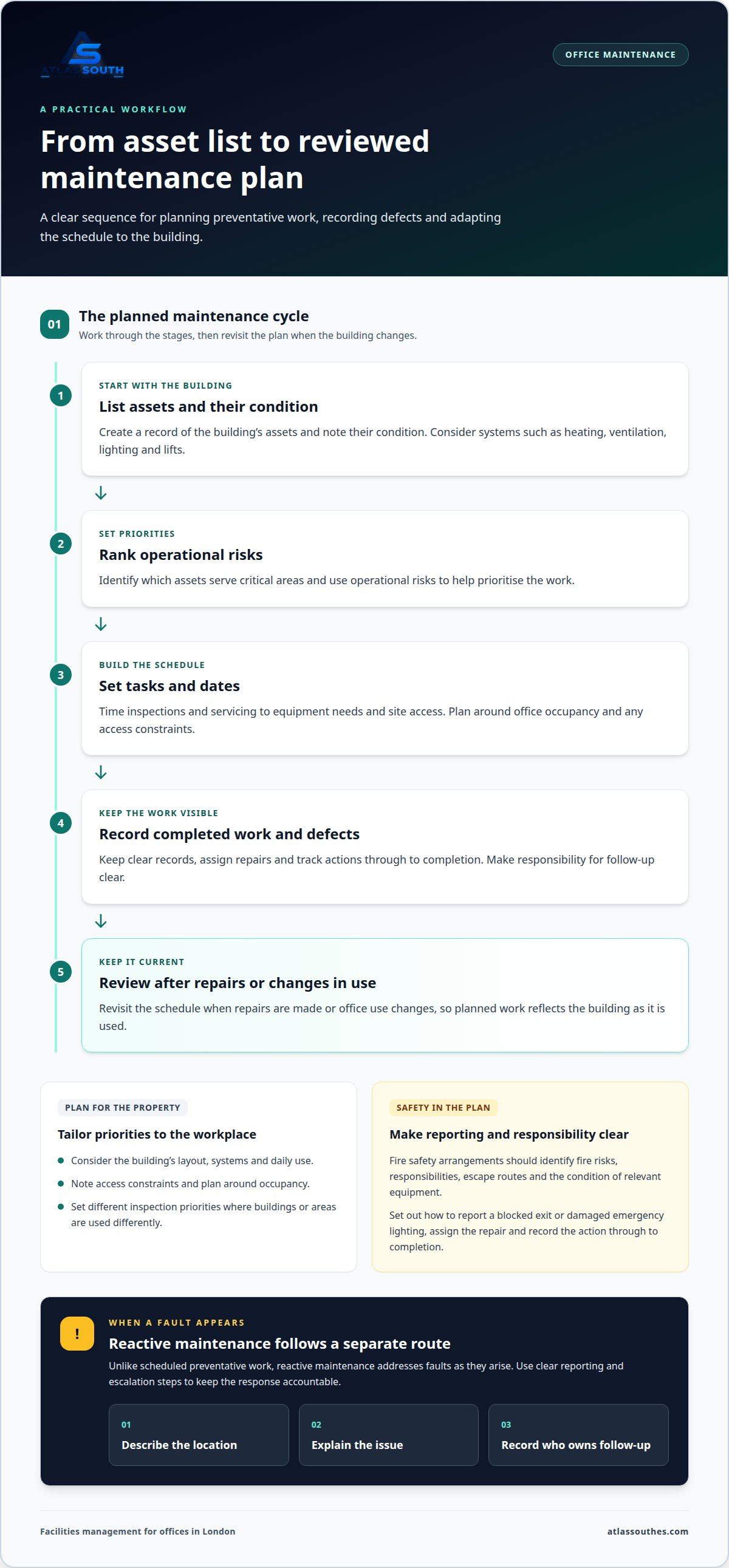
Planned preventative maintenance schedules inspections and servicing before faults disrupt building use. It can cover heating, ventilation, lighting, lifts and other recorded assets, with tasks timed to equipment needs and site access. To create an office facilities management plan, list assets and their condition, rank operational risks, set tasks and dates, then record completed work and defects. Review the schedule after repairs or changes in office use.
Tailored property maintenance
Effective property maintenance starts with the building’s layout, systems and daily use. A Central London office with shared areas, meeting rooms and several floors may need different inspection priorities from a small, single-floor workplace. Record which assets serve critical areas, note access constraints and plan work around occupancy. Electrical maintenance can include scheduled checks and repairs to lighting or power systems. Reactive maintenance addresses faults as they arise, supported by clear reporting and escalation steps.
Fire safety and building maintenance requirements
UK office fire safety arrangements should identify fire risks, responsibilities, escape routes and the condition of relevant equipment. Building maintenance plans should also explain how teams report defects, assign repairs and record completed work. For example, set out how to report a blocked exit or damaged emergency lighting, then track the action to completion. Coordinate these procedures with building access and maintenance schedules.
Office energy efficiency and cost reduction
Facilities management can support energy efficiency by reviewing how office systems operate and addressing avoidable use. Check heating and ventilation schedules against occupancy, inspect lighting controls, and log recurring faults such as equipment running outside working hours. A planned review of utility use can identify areas for investigation. Prioritise practical changes, then compare later readings under the same operating conditions to assess their effect on consumption and costs.
Workplace and facilities professionals may oversee health and safety, risk, business continuity, procurement, sustainability, space planning, energy, property and asset management. Bringing these responsibilities into view helps define the maintenance division’s remit and shows how building work relates to wider workplace and facilities duties.
Office maintenance services in London
Facilities management for offices in London brings together practical services that keep workplaces operating and organised. Workplace and facilities professionals typically oversee catering, cleaning, building maintenance, environmental services, security and reception. In a Central London office, a building contact might coordinate a reception issue, a plumbing fault and a request about shared-space upkeep through separate service routes. Clear ownership helps staff know where to raise each issue and who tracks its progress.
The service mix should reflect how each building operates. Map shared spaces, occupied areas, access arrangements and recurring requests. A multi-tenant office, for example, may need different arrangements for communal areas and individual suites. A workplace with frequent visitors may give reception and security greater prominence. Reviewing requests with building users helps distinguish regular requirements from one-off problems and shape facilities management for offices around actual patterns of use.
- Building upkeep: record faults such as damaged doors or lighting problems, then assign follow-up.
- Cleaning: set priorities for reception, meeting rooms, kitchens and washrooms based on how occupants use them.
- Security and reception: coordinate visitor procedures, access arrangements and the handling of incoming requests.
- Environmental services: plan practical tasks such as waste handling and keeping shared areas clear.
In Central London, building access and office occupancy can affect how work is arranged. A repair in a busy reception area, for instance, may need to be coordinated with the people using that space. A service schedule should identify the affected area, responsible contact and how staff will receive updates. This helps facilities management for offices account for interruptions in workspaces and shared facilities while keeping outstanding tasks visible.
For a new fault, use a consistent reporting route: describe the location, explain the issue and record who owns the follow-up. A damaged door and a failed light need different responses, but both benefit from a clear record and next step. Reactive maintenance support can help address faults, with attention directed to the affected area and its use.
Facilities management teams and specialist partners
Facilities teams coordinate services that support business performance, bringing building operations and workplace needs into one process. In a Central London office, a facilities lead might connect reception reports, cleaning schedules and a specialist attending to faulty equipment. Clear roles help each request reach the right person and make follow-up visible.
Choose a facilities management company by comparing its service scope with your building’s daily needs. Ask how it will allocate responsibility, handle requests and coordinate specialist partners. For example, check that each reported fault has an owner, a recorded status and a route for escalation. A practical service plan should also explain how performance and recurring issues will be reviewed.
In UK offices, health and safety and risk management form part of facilities oversight. Teams can coordinate risk reviews, track reported hazards and arrange follow-up with the relevant specialist. For example, a damaged floor surface should be recorded, assessed and addressed, with the responsible person and next action made clear.
- Facilities lead: receives requests, assigns ownership and keeps a record of progress.
- Cleaning team: reports issues such as a spill or damaged washroom fitting through the agreed route.
- Security staff: support building access procedures and pass relevant incidents to the responsible manager.
- Specialist partner: handles technical work within its area, then reports completion or outstanding action.
Poor coordination can leave faults unresolved, create confusion over responsibility and disrupt office routines. A recurring leak, for instance, may affect work areas if reports are missed or follow-up is unclear. Teams can reduce these gaps by recording each request’s location, issue, assigned contact and status.
Review open requests, repeated faults and staff feedback regularly. If several reports concern the same meeting room, investigate the shared cause instead of treating each report in isolation. This connects daily service delivery with broader decisions about risk, business continuity, procurement and space planning.
Comparing in-house and outsourced facilities management
An in-house team works directly within your organisation and understands its routines. For example, staff can report a faulty meeting-room light to a colleague who knows the building. This model gives managers direct oversight of priorities, communication and daily task allocation. The organisation must also coordinate the team’s workload and arrange specialist support when a task requires specific skills.
Outsourcing assigns agreed facilities responsibilities to an external provider. A single point of contact can coordinate services and route a request, such as a heating fault, to the appropriate specialist. This can reduce the need for your own team to manage each service separately. Your organisation still needs clear service expectations, reporting routes and a process for reviewing performance.
Compare the models against the actual work your office requires. List recurring tasks, specialist jobs, peak periods and the internal time available for coordination. For instance, an office with regular events may need cleaning support that can adapt to venue use. A workplace with frequent equipment faults may prioritise a reliable process for reporting, assigning and tracking repairs.
A hybrid arrangement can keep day-to-day oversight in-house while outsourcing defined services. An internal manager might set priorities and monitor requests, while external specialists handle technical maintenance. This can preserve local knowledge without requiring internal staff to cover every discipline. It works best when responsibilities, handovers and escalation steps are clearly documented.
- Choose in-house management when direct control and close knowledge of office routines are priorities.
- Consider outsourcing when coordinating specialist services internally creates a workload challenge.
- Use a hybrid model when internal oversight matters, but selected tasks need external delivery.
Before deciding, map the services, owners and reporting steps for a typical fault. Then compare how each model would handle that same request, from first report to completion. To discuss an outsourced approach, explore facilities management support for your office.
Atlas South Technical Service: Facilities Management
Atlas South Technical Service provides facilities management for commercial workplaces, coordinating building services through one contract. Turn to its team when you need clearer oversight of office maintenance and related workplace services, rather than managing each arrangement separately.
Its services include commercial cleaning, security and venue and events cleaning. Office cleaning and event cleaning can be coordinated alongside the building’s regular operational needs, with responsibilities organised around how the workplace is used. This helps property professionals bring service coordination into one management arrangement.
To discuss facilities management for your office, contact Atlas South Technical Service or visit atlassouthes.com.
Set a clear direction for your workplace
Start by defining what a well-managed office needs to deliver. Identify the issues that interrupt staff, the services that need closer coordination and the responsibilities you want to retain internally. This gives you a practical basis for shaping facilities management for offices around your workplace, rather than adopting a generic arrangement.
Atlas South Technical Service provides facilities management, commercial cleaning and security services. Together, these services support a coordinated approach to building operations and workplace requirements. Identify which responsibilities would benefit from clearer oversight, then discuss how they could fit your office’s needs.
Contact Atlas South Technical Service to discuss your workplace requirements and possible next steps. A clear starting point can help you plan with confidence and keep the office focused on its core work.
Frequently Asked Questions
What does office facilities management include?
Office facilities management coordinates the people, processes and building services needed to keep a workplace operating. Its scope can also cover practical changes, such as preparing a floor for a new team or coordinating access during a move. Record who approves work, who receives updates and where handover details are stored. This gives staff and building contacts a shared operating reference.
What facilities management services do UK offices need?
UK offices need services matched to their building, occupancy and daily operations. A shared office with frequent visitors may prioritise reception, access arrangements and communal-area upkeep, while a workplace hosting regular events may need planned post-event cleaning. Map the building’s spaces and busiest periods, then match each requirement to a responsible service. Review the arrangement when teams, occupancy or office use changes.
