

A facilities management contract can organise building operations, but it does not transfer legal responsibility for workplace safety.
Facilities management compliance for buildings means meeting the legal duties that apply to a site and keeping records of how risks are controlled. Employers and duty holders remain responsible, even when facilities teams support this work.
Knowing the rules is only part of the task. You also need up-to-date risk records, clear ownership of actions, competent contractors and inspection schedules suited to the building’s systems and use. This guide explains statutory compliance and how to organise checks, evidence and contractor controls, including planned maintenance across a site or property portfolio.
Key Takeaways
- Map the legal duties that apply to each building and distinguish them from voluntary standards or maintenance guidance.
- Link each compliance record to its site and asset, then assign an owner, due date and escalation route to any required action.
- Before work starts, make sure contractors have appropriate competence, insurance, permits and site information.
- Build equipment checks into planned maintenance: PUWER and LOLER cover different aspects of work equipment safety.
What Is Statutory Compliance in Facilities Management?
Statutory compliance means meeting the legal duties that apply to a building’s operation and keeping evidence of the controls in place. Requirements depend on the building’s use, installed systems and potential risks to people.
The scope of building compliance
Compliance covers operational, safety, environmental, regulatory and cyber-physical risks. It matters because failures can affect occupants, building operations and the evidence that risks were managed.
For example, consider how access control and connected building systems are managed alongside waste handling and energy use. Environmental obligations depend on the premises and its activities, so identify the requirements relevant to each site rather than relying on a generic checklist.
Health and safety responsibilities
The Management of Health and Safety at Work Regulations 1999 require risks to be assessed and mitigated. According to the UK legislation register, the Workplace (Health, Safety and Welfare) Regulations 1992 cover the physical workplace environment, including welfare facilities.
Day-to-day controls include identifying hazards, keeping routes safe and addressing defects. Breaches of the Health and Safety at Work etc. Act 1974 can result in uncapped fines.
Fire, electrical and water safety checks
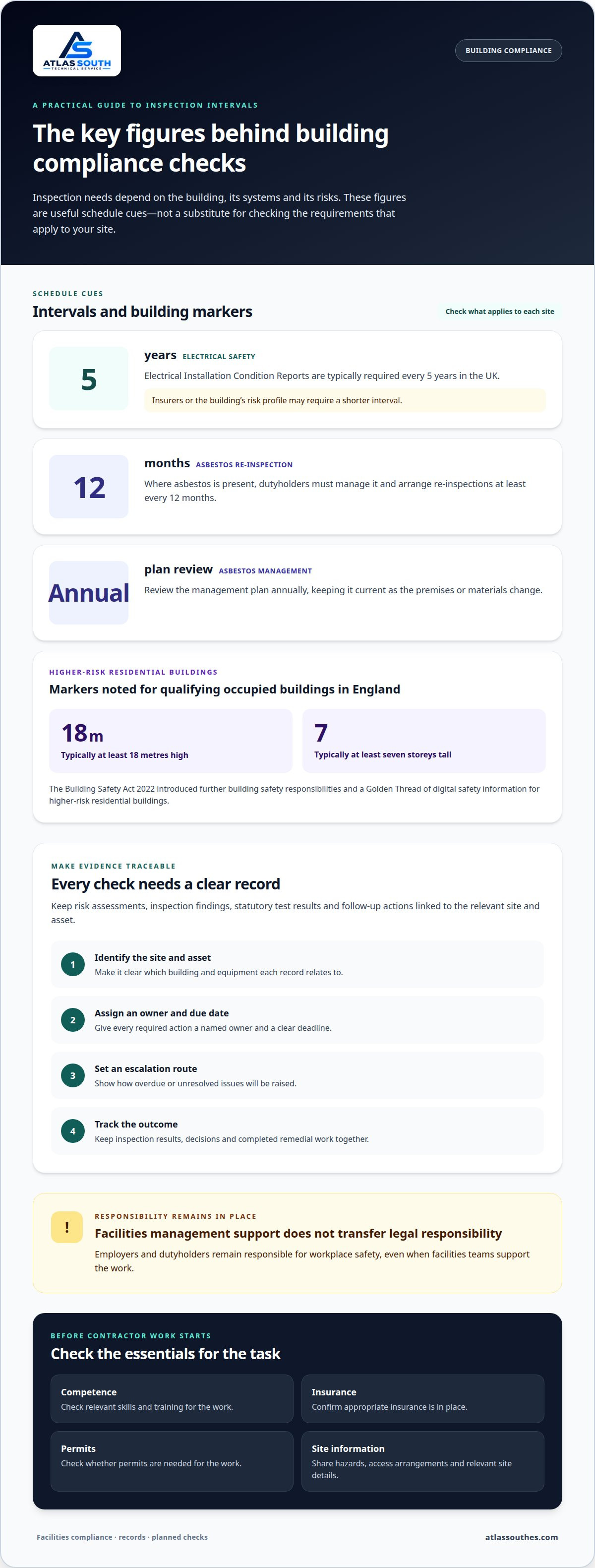
In England and Wales, the Regulatory Reform (Fire Safety) Order 2005 places duties on responsible persons. Fire safety requirements should be considered as part of a building’s compliance arrangements. Electrical Installation Condition Reports are typically required every 5 years in the UK, though insurers or risk profiles may require shorter intervals.
The Gas Safety (Installation and Use) Regulations 1998 establish relevant duties. Lift and pressure-system inspection requirements depend on the equipment and applicable rules. Keep test results and remedial work records with the relevant asset. Water hygiene controls should reflect risks identified in the building’s water systems.
Duties for higher-risk buildings
The Building Safety Act 2022 introduced further building safety responsibilities and a Golden Thread of digital safety information for higher-risk residential buildings. In England, qualifying occupied higher-risk residential buildings are typically at least 18 metres high, according to the Building Safety Regulator.
Keep safety information current when building conditions or arrangements change. The Building Safety Regulator also identifies qualifying occupied buildings as typically at least seven storeys tall.
Ongoing risk assessment and documented actions
For UK commercial buildings, required inspections and records depend on the premises, hazards and equipment. Keep risk assessments, inspection findings, statutory test results and follow-up actions linked to each site and asset.
Ongoing risk assessments and inspections
Ongoing assessment connects site changes with appropriate controls and inspections. This helps your team respond when building use, condition or work activities change. Review relevant assessments after an incident or significant change to the premises. Compare inspection findings with the related risk record, assign corrective actions to named owners, and track progress until each issue is resolved. Retain evidence of the outcome.
Asbestos and Legionella risk control
The Control of Asbestos Regulations 2012 require dutyholders to manage asbestos where it is present. Keep the management plan current, share relevant information with people carrying out work, and arrange re-inspections at least every 12 months. Review the plan annually so changes to the premises or materials inform controls.
For Legionella, document the assessment and controls for the building’s water systems. Keep monitoring results, maintenance records and corrective actions together. Changes in system use or periods of low occupancy can alter the risks, so review whether existing controls remain suitable.
Reporting, records and audit trails
Central reporting gives you a view of compliance across sites instead of leaving evidence in separate files or inboxes. Link each record to the relevant asset and show whether it is current. For every open action, record the owner, due date and escalation route. Managers can then compare progress across locations and spot patterns such as recurring faults or overdue work.
After an incident, a clear timeline can show the finding, decision and follow-up. Keep evidence together, including inspection results and records of completed work. If routine hygiene forms part of site controls, commercial cleaning support can help maintain consistent cleaning records.
Contractor competence, insurance and site access
Assess compliance by mapping duties to each site, then reviewing contractor competence, insurance, permits and work evidence. There’s no standard cost for compliance; it depends on building size, asset condition, inspection needs and service scope, with a quote reflecting those factors.
Contractor competence and site access
Contractor pre-checks establish whether people have suitable competence, insurance, permits and site information before work starts. These checks matter because unfamiliar systems, restricted areas and live operations can create risks if access is not controlled properly.
Match evidence to the task. For planned work on building equipment, for example, check relevant training and insurance, then share site hazards and access arrangements. Record who approved entry, what information they received and any access limits. Keep these details with the work record so responsibilities can be traced if an unexpected issue arises.
Coordinating contractors and safe working
Coordination aligns contractor activities with building operations and helps reduce clashes between planned work and occupied areas. It is especially important when several teams need access to the same asset or work could affect staff, visitors or other contractors.
Before work begins, agree the task, timing, access route and person responsible for coordination. Share relevant site information, including known hazards and operational constraints. For example, schedule noisy repairs away from busy reception periods where practicable. Record changes to the work plan and communicate them to affected teams. If an unexpected fault changes the task, pause and reassess the controls before work continues.
Compliance duties and supporting evidence
Clear responsibilities and records show how an organisation oversees contractor work and follows up on issues. Appointing a contractor does not remove the need to manage site risks and responsibilities.
Facilities management contracts commonly use single-service, bundled or integrated models. A single-service arrangement covers a defined task; bundled or integrated models coordinate more services through shared processes. Set out who arranges checks, approves work and closes actions. Keep insurance and competence records, permits, inspection results and completion evidence together. Review overdue actions and contract responsibilities during routine reporting to keep gaps visible across sites and teams.
Inspection schedules and compliance checks
Maintain records that connect each building asset with its inspections, findings and follow-up. A facilities manager should retain risk assessments, maintenance histories, inspection reports, test results and evidence of completed remedial work.
According to the UK legislation register, PUWER 1998 and LOLER 1998 are regulations governing work equipment and lifting equipment in the UK.
Plan checks around equipment type, condition, use and identified risks. Planned maintenance organises inspections, routine servicing and testing into a schedule, helping teams spot deterioration before it affects safe operation or interrupts building services.
For lifting equipment, LOLER covers safe use and thorough examination, while PUWER addresses wider work equipment safety. Make the inspection scope clear for each asset, record defects and track any necessary repairs before returning affected equipment to use. The applicable checks depend on the equipment and how it is used.
For estates with multiple sites, use a shared register to identify each asset, its location, inspection status and next action. Review overdue checks and recurring defects together. A repeat fault may indicate a wider condition issue or an ineffective maintenance schedule.
Capture findings during the inspection. A useful audit trail records what was checked, when, by whom and against which requirement. Add photographs or timestamps where they help show the condition found and the work completed. Link each record to the relevant asset and preserve its action history.
When an inspection identifies a problem, assign an owner and record the planned response. Keep the original finding with repair evidence and any follow-up inspection. This makes it easier to trace how the issue was handled and demonstrate timely intervention if an incident occurs.
To organise inspections and maintenance across your building, discuss planned facilities management.
Atlas South Technical Service: Facilities Management
Atlas South Technical Service provides Facilities Management for commercial buildings that need coordinated day-to-day oversight. Its team can help when inspections, maintenance and site services need clearer coordination across your premises.
Facilities Management brings building operations together through one contract. Commercial Cleaning and Security Services can support the routine operation of occupied sites, while Venue and Events Cleaning supports event-related needs. Property owners and managing agents can coordinate these services around their building’s requirements.
Compliance duties remain with the relevant duty holders, but well-organised facilities support can help keep tasks, records and maintenance visible. Tell Atlas South Technical Service about your property or development, or visit atlassouthes.com.
Make your next compliance priority clear
Use your next review to identify the operational issue that needs attention first. It might be an overdue action, unclear responsibility or a handover that has left building records disconnected. Set that priority against how people use the premises and the work already planned. This gives your team a practical starting point for improving facilities management compliance for buildings, without adding a generic process that does not fit the site.
Atlas South Technical Service provides Facilities Management, Commercial Cleaning and Security Services for commercial sites. Its team can discuss how these services fit your operational requirements, while statutory duties remain with the relevant duty holders. Bring your site priorities and service responsibilities to the discussion so the next steps reflect your building’s needs.
Contact Atlas South Technical Service to discuss your property and facilities requirements.
Contact Atlas South Technical Service
Frequently Asked Questions
Which UK laws and regulations apply to building facilities management?
Applicable rules depend on the building, its use, equipment and risks. Key examples include the Health and Safety at Work etc. Act 1974, the Management of Health and Safety at Work Regulations 1999, and the Electricity at Work Regulations 1989. Asbestos controls sit under the Control of Asbestos Regulations 2012. For qualifying higher-risk residential buildings, the Building Safety Act 2022 adds building safety responsibilities. Map requirements to each site and asset.
What are the fire safety compliance duties for UK building owners and facilities managers?
In England and Wales, the Regulatory Reform (Fire Safety) Order 2005 places duties on responsible persons. They must address fire risks and keep suitable arrangements for people on site. Facilities managers can support this by coordinating checks, maintaining fire-system records and tracking remedial actions. For non-domestic premises, the article’s stated cadence is monthly fire-system checks and an annual fire risk assessment review. Record findings and follow-up against the relevant building.
What are the building water hygiene and Legionella compliance requirements in the UK?
Manage Legionella risk through a site-specific assessment, suitable controls and documented monitoring. The water system’s design, use and condition shape the risks and required checks. Changes in occupancy or water-system use, for example, should prompt a review of existing controls. Keep monitoring results, maintenance work and corrective actions together so a building manager can trace what was observed and how the team responded.
How often should facilities management compliance checks and statutory inspections be carried out?
Inspection frequency depends on the equipment, its use, condition and risk assessment. Electrical Installation Condition Reports are typically required every 5 years in the UK, although insurers or risk profiles may require shorter intervals. Fire-system checks and fire risk assessment reviews should be scheduled according to the building’s needs. The HSE does not require annual PAT testing for every workplace, so set testing around equipment risks and use.


