

The hardest part of managing several buildings is keeping maintenance consistent across every site. Multi-site facilities management brings maintenance requests, planned work and records into a coordinated process. A multi-site facilities manager oversees this work, helping teams prioritise repairs, schedule preventive maintenance and clarify responsibilities across the portfolio.
That coordination matters. Sites can have different equipment, workloads and recurring issues, so a shared approach needs clear processes and reliable information. Centralised maintenance gives managers a clearer view of outstanding tasks and helps teams respond consistently.
This article explains what a multi-site facilities manager does and how centralised maintenance works in practice. It covers preventive maintenance, common portfolio-wide challenges and the processes that help keep work organised. You’ll also learn what to consider when arranging facilities management across multiple commercial buildings.
Key Takeaways
- Use one consistent process to log, prioritise and track maintenance requests across every site.
- Give a facilities manager clear responsibility for coordinating building operations and follow-up.
- Use maintenance records to plan preventive work and spot recurring issues before they disrupt operations.
- Review where fragmented information or inconsistent processes slow teams down, then align the approach across the portfolio.
Centralised maintenance management
Computer-aided facilities management software can bring maintenance activity, compliance records and asset performance into one reporting view. For multi-site facilities management, a shared system gives teams one place to record requests and track work.
Centralised maintenance coordination
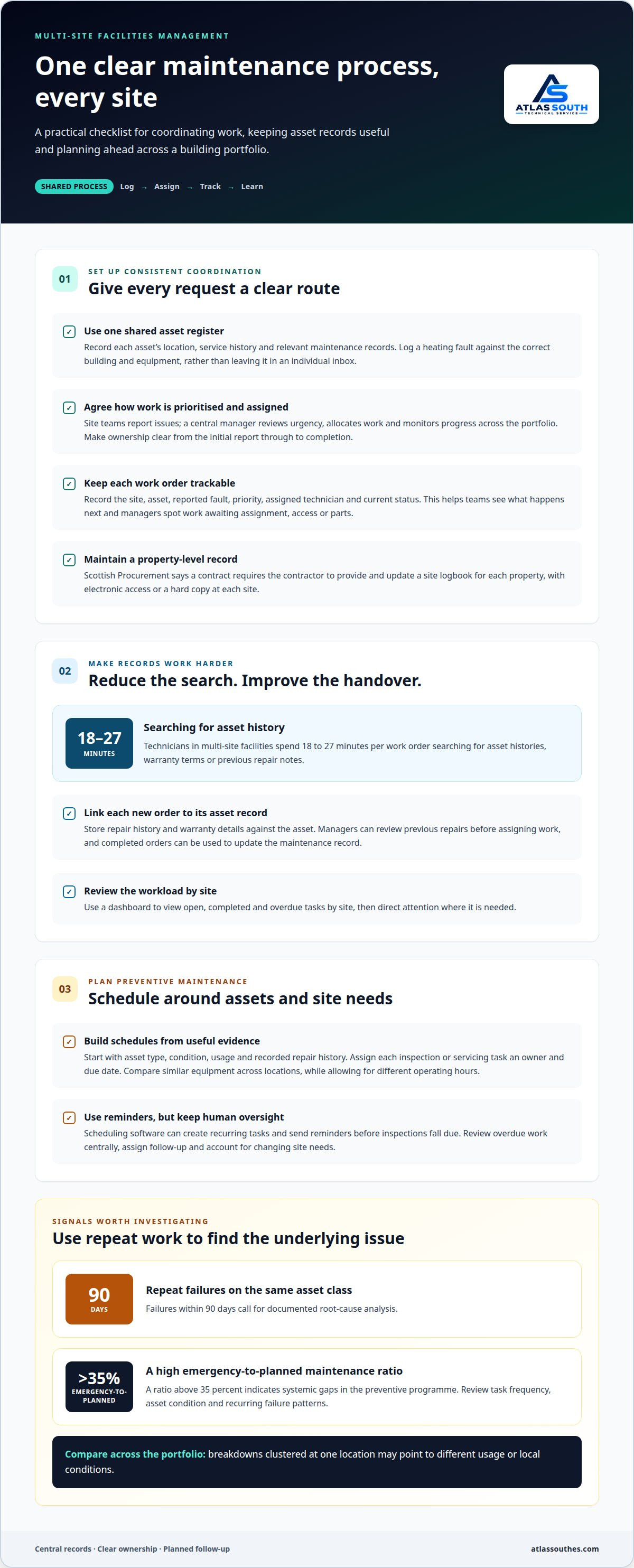
A central coordination process gives each site the same route for reporting faults, assigning work and recording completion. Start with a shared asset register that records each asset’s location, service history and relevant maintenance records. For example, log a heating fault against the correct building and equipment rather than leaving it in an individual inbox.
Next, set a clear process for prioritising requests and assigning responsibility. Site teams can report issues while a central manager reviews urgency, allocates work and monitors progress across the portfolio. Scottish Procurement says a contract requires the contractor to provide and update a site logbook for each property, with electronic access or a hard copy at each site. This creates a property-level record alongside central oversight.
Centralised work order management
A central work-order system turns each maintenance request into a trackable task. Record the site, asset, reported fault, priority, assigned technician and current status. These details help managers compare open work across buildings and identify requests awaiting assignment, access or parts. They also give site teams a consistent way to see what happens next.
Central records matter when staff need an asset’s repair history. Technicians in multi-site facilities spend 18 to 27 minutes per work order searching for asset histories, warranty terms or previous repair notes. Store those details against the asset record, then link each new work order to it. Managers can review previous repairs before assigning work and use completed orders to update maintenance records. A dashboard can then show open, completed and overdue tasks by site, helping managers direct attention where it is needed.
What is a multi-site facility manager?
A multi-site facilities manager coordinates building operations, shared processes and local priorities, connecting portfolio-wide oversight with each property’s needs.
Coordinating operations across buildings
The manager aligns maintenance, access, cleaning and security requirements across buildings. For example, they can compare a recurring heating fault at one site with equipment issues elsewhere. When assessing a provider, consider proposed responsibilities, reporting methods, site coverage and escalation processes. Look for clear ownership from the initial report through to completion, not just a list of services.
Standardising processes across sites
Standardisation gives staff a consistent way to report issues, record checks and escalate urgent work. A shared process should still accommodate local instructions, such as site access arrangements or building operating hours. When comparing in-house, outsourced and integrated management, consider internal capacity, coordination needs and desired accountability. In-house teams retain direct control, while outsourced or integrated arrangements move more coordination outside the organisation.
Mobile reporting across facilities
Mobile reporting lets on-site staff record issues where they find them. A useful report identifies the building, location, asset, problem and any immediate access constraints. Staff can add a photograph or progress note if the system allows. Managers can review reports centrally, assign follow-up and compare outstanding work between sites. The key test is whether updates reach the shared record used by the wider team.
Compliance and contract requirements
UK compliance depends on each property, its equipment and the activities carried out there. Map applicable duties, inspections, records and responsible roles for every site rather than assuming one checklist fits all. A contract should define site-level responsibilities, reporting, escalation, record-keeping and how changes are handled. Scottish Procurement says the contract requires a contractor to provide and update a site logbook for each property, with electronic access or a hard copy at each site. These records help clarify what work was completed and where.
Preventive maintenance
Preventive maintenance schedules work before faults interrupt site operations. Across a multi-site portfolio, asset use and local operating demands should shape the schedule.
Preventive maintenance planning
Start with asset type, condition, usage and recorded repair history. Then assign each inspection or servicing task an owner and due date. Hospitality sites, for example, can use maintenance records to plan ahead and allocate resources efficiently. Compare similar equipment across locations, but account for differences in operating hours. Repeat failures within 90 days on the same asset class call for documented root-cause analysis.
Automated maintenance scheduling
Scheduling software can create recurring tasks and send reminders before inspections fall due. Base schedules on the asset register, task requirements and each building’s operating patterns. For example, a reminder can prompt a site team to arrange access before planned equipment servicing. Review overdue tasks centrally and assign follow-up responsibility. Automation supports routine administration, but managers still need to address missed work and changing site needs.
Maintenance reporting and analytics
Reports can bring maintenance activity, compliance and asset performance into one view. Compare completed and outstanding tasks by site, asset type and recurring fault. An emergency-to-planned maintenance ratio above 35 percent indicates systemic gaps in the preventive programme. Use that signal to review task frequency, asset condition and recurring failure patterns. In a portfolio, breakdowns clustered at one location may point to different usage or local conditions.
Real-time maintenance data
Current work-order updates show managers where tasks are slowing down. If one site repeatedly takes longer to resolve requests, review its workload, access arrangements and process steps. Then adjust resources or procedures to address the cause. Use live status information alongside maintenance history, not instead of it. Managers can prioritise open work and identify developing issues while details remain visible across the portfolio.
Multi-site facilities management challenges
Fragmented records make it harder to see maintenance needs across a portfolio. Fragmented facility data systems typically account for 14 to 19 percent of total maintenance expenditure before technology intervention. Separate spreadsheets, inboxes and local processes can also make it difficult to compare sites consistently.
The time cost can be substantial. Across 50 weekly work orders at five sites, fragmented asset information can waste 75 to 112 technician hours monthly. Managers can reduce avoidable searching by aligning asset records, work-order categories and reporting processes. Clear ownership also helps each site know who handles a new request and who follows up.
Inventory presents another portfolio-wide challenge. Multi-site facility operations carry 22 to 35 percent excess inventory to compensate for visibility gaps, yet still experience 8 to 12 percent stockout rates on critical components. Compare stock levels and usage across locations, then distinguish essential site-specific parts from items that can be managed centrally.
How should a business transition to a multi-site facilities management contract? Start by mapping current services, site responsibilities, asset records and open work. Agree the scope, reporting route, escalation process and handover arrangements before transferring responsibilities. The NHS identifies continuous monitoring of key services as essential to maintaining business continuity across its sites, making service oversight an important part of transition planning.
Set a transition plan that protects continuity while teams adopt shared processes. Track open work, key service updates and unresolved site-specific issues through the handover. A coordinated approach can help clarify responsibilities across buildings and reduce gaps between local teams. Discuss a coordinated portfolio plan for your facilities.
Atlas South Technical Service: Facilities Management
Atlas South Technical Service provides facilities management for commercial buildings that need coordinated oversight across multiple locations. Its planned facilities management can help property teams organise maintenance, address building issues and clarify day-to-day responsibilities.
Consider facilities management when local teams need more consistent coordination across a portfolio. Commercial cleaning and security services can also support building operations, while venue and events cleaning suits sites with event-related requirements. The right combination depends on each property’s use and operational needs.
For a practical starting point, outline your locations, current processes and the areas that need coordination. This creates a clear basis for discussing how facilities management can support your portfolio. Contact Atlas South Technical Service to discuss your requirements.
Set a clear direction for your facilities portfolio
Turn your multi-site facilities management priorities into a practical brief. Record each building’s operating needs, key contacts, access arrangements and current service responsibilities. This gives decision-makers a shared starting point for agreeing what to manage consistently and where each site needs a different approach.
Use the brief to define the outcomes that matter to your organisation, such as clearer reporting, coordinated maintenance planning or consistent support for building users. Set out who will review progress and how teams will raise issues, so the operating model has clear ownership from the start.
Atlas South Technical Service provides Facilities Management, Commercial Cleaning and Security Services for commercial buildings. These services can support organisations seeking a coordinated approach to building operations and site requirements.
To discuss your portfolio’s needs, contact Atlas South Technical Service. A clear brief is a useful first step towards a more organised operating plan.
Frequently Asked Questions
What is multi-site facilities management?
Multi-site facilities management coordinates building operations and services across several properties. A central portfolio lead can align oversight while local contacts manage property-specific requirements. For example, an office group in London might use shared reporting alongside separate access instructions for each building. This helps decision-makers identify cross-site priorities without treating every property as operationally identical.
What services can be included across multiple sites?
The scope can include facilities management, commercial cleaning, security services, electricals, plumbing and reactive maintenance. Venue and events cleaning may also suit properties that host functions. Atlas South Technical Service provides these services for commercial buildings. A scope document should show which services apply at each property and who coordinates related tasks, such as arranging access for electrical work.
What are the benefits and challenges of managing facilities across multiple UK sites?
Shared oversight can help organisations compare service needs and direct support across a UK portfolio. The challenge is accounting for each building’s use, access conditions and occupant requirements. For example, a busy office and an event venue may need different cleaning schedules. A consistent management framework should allow for these practical differences rather than impose identical arrangements at every property.
How can organisations standardise processes across different sites?
Set common reporting categories, approval responsibilities and review procedures, then document authorised local variations. For example, staff could follow the same route to report a fault while recording building-specific access instructions separately. Assign someone to review exceptions and keep site records current. This makes it easier to distinguish genuine local requirements from undocumented differences in practice.
What are the main risks in facilities management across multiple sites, and how can they be reduced?
Missed maintenance, unclear ownership, outdated records and local service interruptions can affect a portfolio. Reduce these risks by assigning accountable contacts, recording critical equipment and access arrangements, and reviewing unresolved issues centrally. For example, a site lead can flag a disruption through an agreed escalation route. Regular oversight helps managers identify where responsibilities or operating arrangements need attention.
What UK regulations and compliance requirements apply to facilities management across multiple sites?
UK compliance depends on each property, its equipment and the activities carried out there. Map applicable duties, inspections, records and responsible roles for every site. Define site-level responsibilities, reporting, escalation and record-keeping in the contract.


